

Tips and tricks to analyze the color of white wines
When we talk about wines, each person has their own preferences. It is always said that «in the variety is the taste». However, have you ever stopped to analyze where the color of white wines comes from? Therefore, we propose a brief tour of this essential characteristic, taking into account some concepts such as quality, the manufacturing process and age.
In the first place, it is important to know that the colors of a wine can have important variations depending on the aging, concentration and techniques that have been followed in each particular product. In the case of white wines, they are those whose origin is located in green or white grapes, although they can also be made with black grapes without letting the must come into contact with your skin.
How to define the color of a white wine
So that you can correctly appreciate the color of a wine, the first thing you should do is to have the glass half full, holding it by the stem or foot between the thumb and the index, and tilt it creating an angle of between 30 and 45 degrees. Next, look at the edge of the liquid, that is, the specific area where it joins the glass, since here the wine is shown with a smaller thickness and its chromatic variety becomes more evident.
Keep in mind that the light of the place you are in should be as clear as possible, and if it is natural, much better. In addition, use a white background so that there is no element on the back that may hinder your main appreciation.
In this sense, professional tasters opt for white tablecloths on the table to always have a nearby white background. On other occasions, a simple sheet of white paper or a cloth napkin is also enough.
Adjectives to classify the color of white wine
Once the previous process has been completed, the visual definition of a white wine can be carried out following the following terms:
- To specify its color, terms such as colorless, yellow, greenish, lemon yellow, straw yellow, golden yellow or amber are used.
- Regarding the intensity of a white wine, we can say that it is very high, high, medium high, medium, medium low or low.
- And as far as its appearance is concerned, the range of possibilities is also very wide, with adjectives such as crystalline, bright, clear, clean, cloudy, veiled or matte, among others.
White wine color: nuances in observation
After having the right conditions for observation and using the appropriate adjectives for each type of white wine, you can also complete the process with the following more specific nuances and details. Take note:
- White wines are obscured by various factors, although among the most prominent are oxidation by heat, excess light, and even its evolution in the bottle in the absence of oxygen. In addition, these wines can acquire a more amber tone by the transfer of wood coloring from the four months of aging. Like for exemple Josep Foraster blanc Selecció, a fantastic blend of white Grenache and Chardonnay in which part of the wine is aged few months in the barrel.
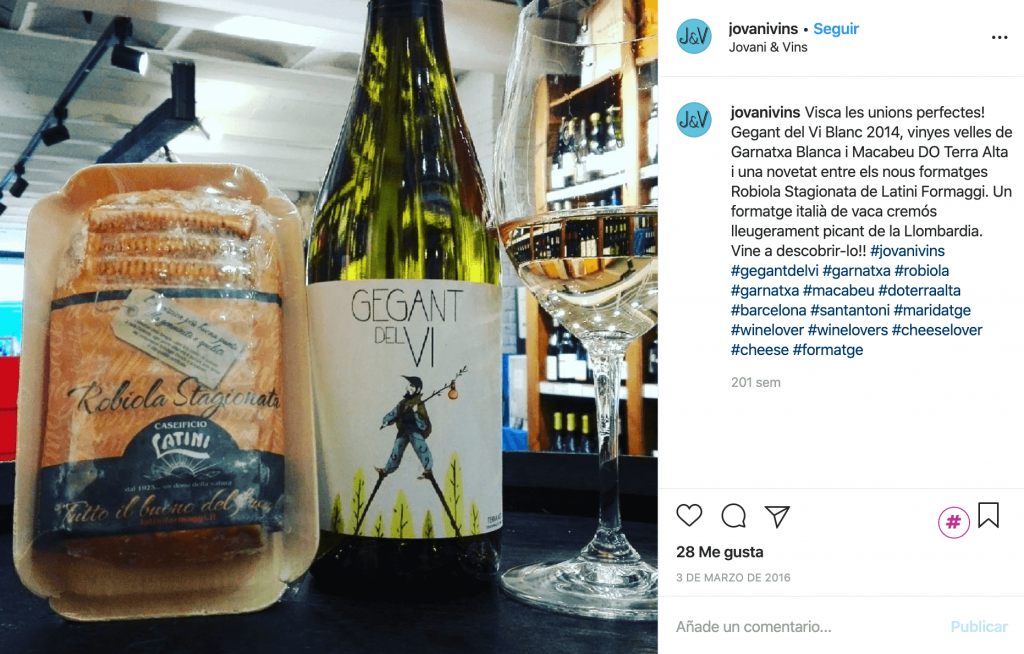
- If the wine observed has a pale and bright white color with a quick foam, it is a young wine, made following the new rules and techniques of the most current oenology. It is a vintage low in sugar and rich in acids. Like Gegant del vi White from Jovani Vins in Terra Alta.
- If the reflections of a white wine are greenish, they indicate that its acidity is greater, apart from the fact that the characteristics of the variety can provide a yellow tone with more or less intensity. For example, the Chardonnay grape tends more towards the yellow color, while the Sauvignon blanc leans towards somewhat paler tones.